Meal Planner: Calculate Your Calories & Get a Free 7-Day Meal Plan
If you’ve ever stared at the fridge wondering what to cook for the week, a good meal planner takes the guesswork out of eating well. The interactive tool below calculates your daily calorie and macro target, builds a 7-day meal plan around it, and turns that plan into a grocery list sorted by aisle — so you can go from “what should I eat?” to a full week sorted in a few minutes.
Below the meal planner, we walk through how the calorie math works, how to pick a diet style that fits your goals, and how to actually stick with the plan once the week gets busy.

Try the Meal Planner
Enter your details in the Calculate tab to get a personalized calorie and macro target, then move to Weekly Plan to generate your 7 days of meals. The Grocery List tab builds itself automatically from whatever plan you generate, and the Tracker tab lets you check off meals as you eat them.
Fit & Care · Health Calculators
Meal Planner
Work out your daily calorie and macro target, generate a 7-day meal plan around it, get a grocery list grouped by aisle, and check off meals as you eat them.
Estimates use the Mifflin-St Jeor formula and standard activity multipliers. This is a general guide, not personalized medical or nutrition advice — check with a dietitian or doctor for specific conditions.
Your week
Choose a diet style, then generate a plan.
Grocery list
Generate your weekly plan on tab 02 first — your grocery list builds automatically from it.
of 0 kcal target
Meal suggestions are general guidance, not medical advice. For specific health conditions or dietary restrictions, check with a registered dietitian or your doctor.
How This Meal Planner Calculates Your Calories and Macros
The calculator behind this meal planner uses the Mifflin-St Jeor equation, which is generally considered one of the more accurate formulas for estimating basal metabolic rate (BMR) — the number of calories your body burns at rest. From there, it multiplies your BMR by an activity factor (sedentary, light, moderate, or very active) to estimate your total daily energy expenditure (TDEE), then adjusts that number up or down based on your goal: a 500-calorie deficit for weight loss, no adjustment for maintenance, or a 300-calorie surplus for muscle gain.
Once your calorie target is set, the tool splits it into protein, carbohydrate, and fat targets based on the diet style you pick. A balanced diet leans toward a roughly 30/40/30 split of protein, carbs, and fat, while keto shifts that heavily toward fat and away from carbs. You can see the exact breakdown as a plate-style chart right after you calculate.
Choosing a Diet Style for Your Meal Plan
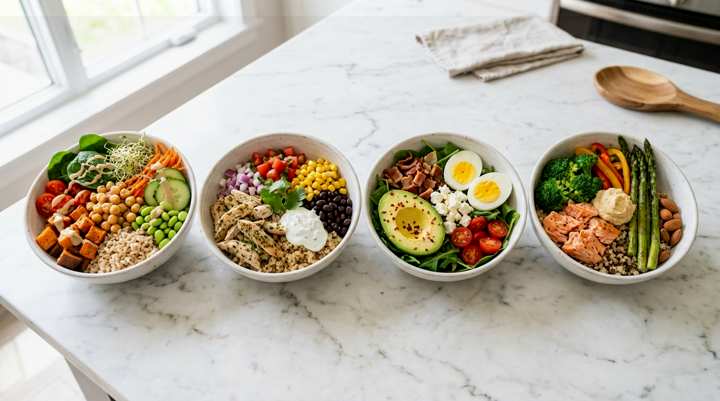
The meal planner supports six diet styles, and it’s worth picking one that actually matches how you already like to eat rather than the one that sounds most “optimal” on paper — the best meal plan is the one you’ll follow past week one.
- Balanced — a general mix of protein, whole grains, and vegetables with no major restrictions.
- Vegetarian — plant-forward meals built around eggs, dairy, legumes, and vegetables.
- Vegan — fully plant-based, leaning on tofu, legumes, and whole grains for protein.
- Mediterranean — olive oil, fish, legumes, and vegetables, with lean meat used more sparingly.
- High-Protein — higher protein targets across every meal, useful if you’re strength training or trying to preserve muscle in a deficit.
- Keto — very low carbohydrate, high fat, built around eggs, meat, cheese, and non-starchy vegetables.
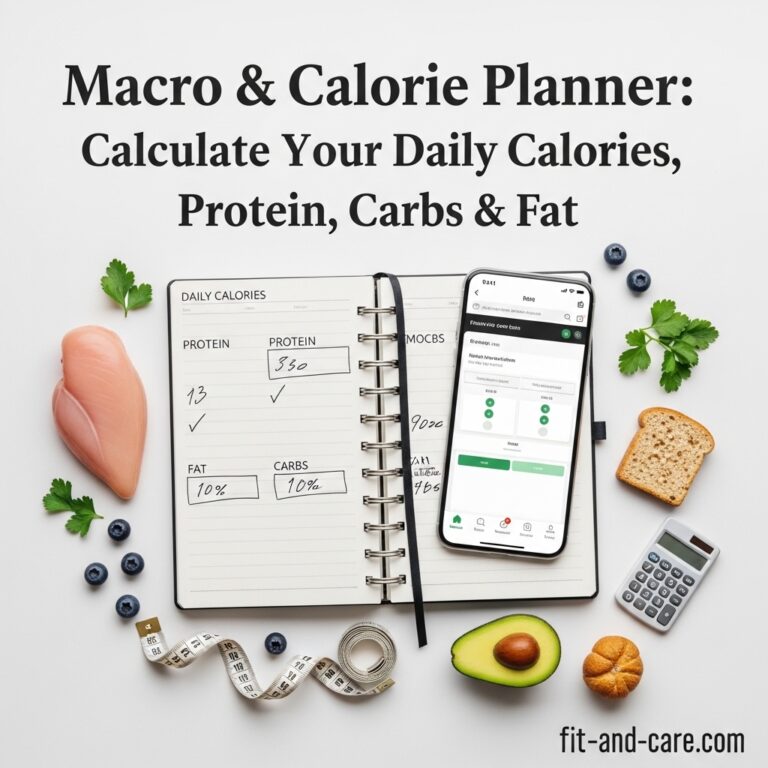
If you’re not sure which one fits, the Macro & Calorie Planner is a good companion tool for exploring different macro splits before committing to a full week of meals.
Building Your Week and Grocery List
Once you generate a plan, each day gets a breakfast, lunch, dinner, and snack pulled from your chosen diet style and scaled to fit your calorie target. Don’t like a specific meal? Use the swap button on that meal’s card to pull a different option from the same diet style without regenerating the whole week.
The grocery list tab then reads every ingredient across all 7 days, combines duplicates, and groups everything by aisle — produce, protein, dairy & eggs, grains, and pantry — so you’re not bouncing back and forth across the store. If you’re cooking for more than one person, adjust the servings number and every quantity scales automatically. You can check items off as you shop, print the list, or copy it as plain text to send to someone else.
Tips for Sticking to Your Meal Plan

A meal plan only works if it survives contact with a real week. A few things that help:
- Batch-cook proteins and grains. Grilling a few chicken breasts or cooking a big pot of rice on Sunday makes weeknight assembly much faster.
- Prep in containers, not just ingredients. Pre-portioning meals into containers removes the decision-making at mealtime, which is often the actual barrier to sticking with a plan.
- Build in one flexible day. Life happens — plan one day with simpler or leftover-based meals so a missed grocery trip or long workday doesn’t derail the whole week.
- Use the tracker. Checking meals off as you go in the Tracker tab keeps you honest about whether you’re actually hitting your calorie target, not just whether you cooked the right food.
For more ready-made ideas, the High-Protein Meal Plan for the Week has a full 7 days of specific recipes if you’d rather follow a set plan than generate your own.
Why Use a Meal Planner Instead of Winging It
Most people don’t struggle with knowing that vegetables and lean protein are good for them — they struggle with the daily decision fatigue of figuring out what that actually looks like on a Tuesday night after work. A meal planner removes that decision from the moment you’re hungry and puts it somewhere calmer: a few minutes on a Sunday.
There’s also a real gap between “eating healthy” in the abstract and hitting a specific calorie or macro target consistently. Without some kind of structure, it’s easy to underestimate portions, snack more than planned, or drift well above or below a calorie goal without noticing. A weekly meal plan built around your actual numbers — not a generic 2,000-calorie template — closes that gap, and pairing it with a grocery list means the healthy option is also the convenient one, since the food is already in the house.
This is especially useful if you’re tracking toward a specific goal like the ones covered in our high-protein meal plan guide, where hitting a protein target every day matters more than it does for general maintenance eating.
Frequently Asked Questions
Is this meal planner free to use?
Yes. The calculator, weekly plan generator, grocery list, and tracker are all free, and nothing you enter is stored or sent anywhere — everything runs in your browser.
How accurate is the calorie calculation?
The Mifflin-St Jeor formula used here is a well-regarded estimate, but it’s still an estimate. Actual calorie needs vary by individual, and factors like muscle mass, medical conditions, and metabolism aren’t captured by any formula. Treat the number as a starting point and adjust based on how your weight trends over a few weeks.
Can I change my diet style mid-week?
Yes — switch the diet style pill in the Weekly Plan tab and generate a new week at any time. Your calorie target carries over, so you don’t have to redo the calculator.
Does the grocery list account for ingredients I already have?
Not automatically. The list reflects everything needed for the full week’s meals, so it’s worth checking it against your pantry and crossing off what you already have before you shop.
Is this meal planner suitable for weight loss and muscle gain?
Yes. Selecting “Lose weight” applies a moderate calorie deficit, and “Gain muscle” applies a moderate surplus paired with a higher protein target if you also choose the High-Protein diet style. Neither setting is extreme, which tends to be easier to sustain than aggressive deficits or surpluses.
What if the meal suggestions don’t fit my allergies or restrictions?
Use the swap button on any individual meal to pull a different option within the same diet style, or treat the plan as a starting template and substitute ingredients as needed. This tool isn’t a substitute for guidance from a registered dietitian if you have a diagnosed condition or complex dietary restriction.
This meal planner provides general nutrition guidance and is not a substitute for personalized medical or dietary advice. If you have a health condition, are pregnant, or have specific nutritional needs, consult a registered dietitian or your doctor before making significant changes to your diet.

Hamza Ahmad is a dedicated fitness and health researcher and the founder of Fit and Care. He specializes in translating evidence-based health science into practical, accessible guidance on nutrition, fitness, and wellness.