
Free Weekly Meal Planner: Build Your 7-Day Diet Plan & Grocery List
⚠️ Disclaimer: This meal planner is for informational and lifestyle purposes only and is not medical or dietary advice. Individual nutrition needs vary. If you have a health condition or specific dietary requirements, please consult a qualified healthcare professional or registered dietitian before making significant changes to your diet.
Table of Contents
Want quick answers without scrolling?
Chat with our free AI health assistant on Telegram, ask about meal plans, macros, or anything else on the site, any time.

Try the Free Meal Planner
Set your diet style, daily calorie target, and how many meals you eat per day, then hit Generate. Don’t like a meal? Hit the shuffle button on that card to swap it for another option in the same diet style.Weekly Meal Planner
Choose a diet style and calorie target to generate a full 7-day plan, portioned to fit your numbers, with a grocery list that builds itself.
How to Use This Meal Planner
Step 1 — Pick Your Diet Style
Choose from Balanced, Keto, Vegan, Vegetarian, Mediterranean, or High-Protein. Each style pulls from its own set of recipes, so a keto week won’t hand you a bowl of rice.Step 2 — Set Your Calorie Target
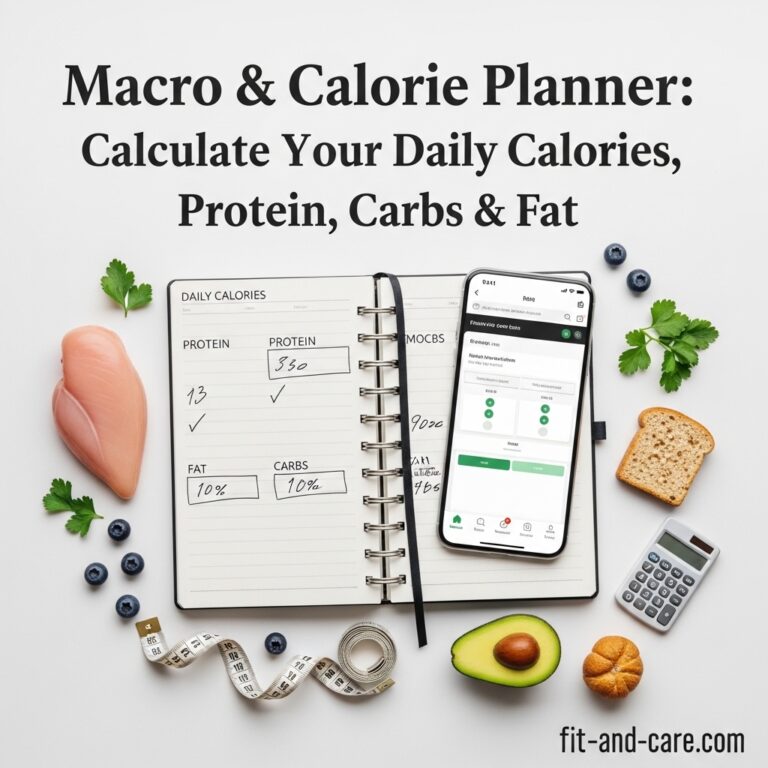
If you already know your number, enter it directly. If you don’t, use the Macro & Calorie Planner first to calculate your personal maintenance, deficit, or surplus target based on your weight, height, and goals.Step 3 — Choose Meals Per Day
3 meals keeps it simple. 5 or 6 spreads the same calories across more, smaller meals — useful if you prefer to graze rather than eat three big plates.Step 4 — Generate, Then Fine-Tune
Hit Generate for a full week. Not a fan of one meal? Shuffle just that card — the rest of your plan stays put, and the grocery list updates automatically.How the Meal Planner Generator Works
This tool draws from a curated library of recipes tagged by diet style, meal type, and macros. When you generate a plan, it selects the combination of meals per day that lands closest to your calorie target, then scales portion sizes up or down so the numbers fit — the same way you’d naturally eat a bit more or less of a dish depending on your goals. Because it works from a fixed recipe set rather than pulling from a massive database, you’ll notice some meals repeat across the week. That’s intentional: real people don’t cook seven completely different dinners every week either. If you want more variety on a given day, the shuffle button is there for exactly that.
The 6 Diet Styles, Explained
Balanced
A flexible mix of lean proteins, whole grains, fruits, and vegetables. Good default if you’re not following a specific diet and just want a well-rounded week.Keto
Very low carb, high fat. Meals lean on eggs, meat, fish, cheese, and non-starchy vegetables, keeping net carbs low across the day.Vegan
Entirely plant-based — tofu, tempeh, legumes, whole grains, and vegetables stand in for animal protein. If you’re building a plant-forward diet, our guide on protein-rich foods for vegetarians is a useful companion.Vegetarian
Plant-based with eggs and dairy included, giving a bit more flexibility than vegan while still cutting out meat and fish.Mediterranean
Olive oil, fish, legumes, whole grains, and fresh vegetables, with lean meat used more sparingly — one of the most consistently well-studied eating patterns for long-term health.High-Protein
Every meal is built around hitting a higher protein number, useful if you’re strength training or trying to preserve muscle in a calorie deficit. For a deeper dive, see our full 7-day high-protein meal plan.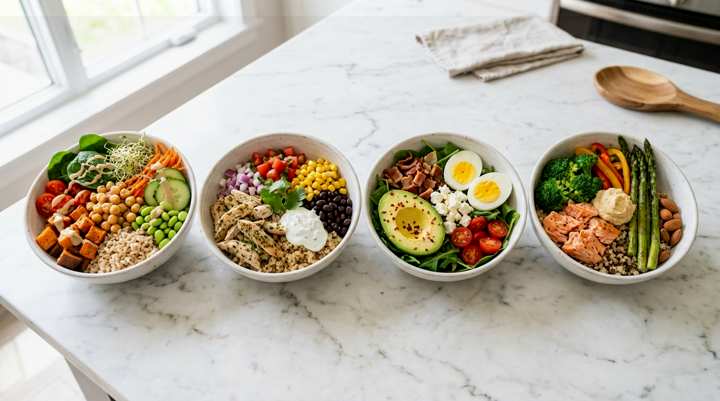
Meal Planner for Weight Loss, Muscle Gain and Maintenance
The meal planner is only as useful as the calorie number you give it, so start by deciding what you want your body to do. Find your maintenance calories first, then adjust:
- Weight loss: eat about 300 to 500 calories below maintenance. Choose the Balanced, Mediterranean or High-Protein style to stay full. As a general rule, avoid going below 1,200 calories (women) or 1,500 calories (men) unless a doctor is supervising you.
- Maintenance: enter your maintenance calories exactly and pick whichever style you enjoy most. Variety is what keeps people consistent.
- Muscle gain: eat roughly 250 to 500 calories above maintenance and choose the High-Protein style. Pair your plan with strength training.
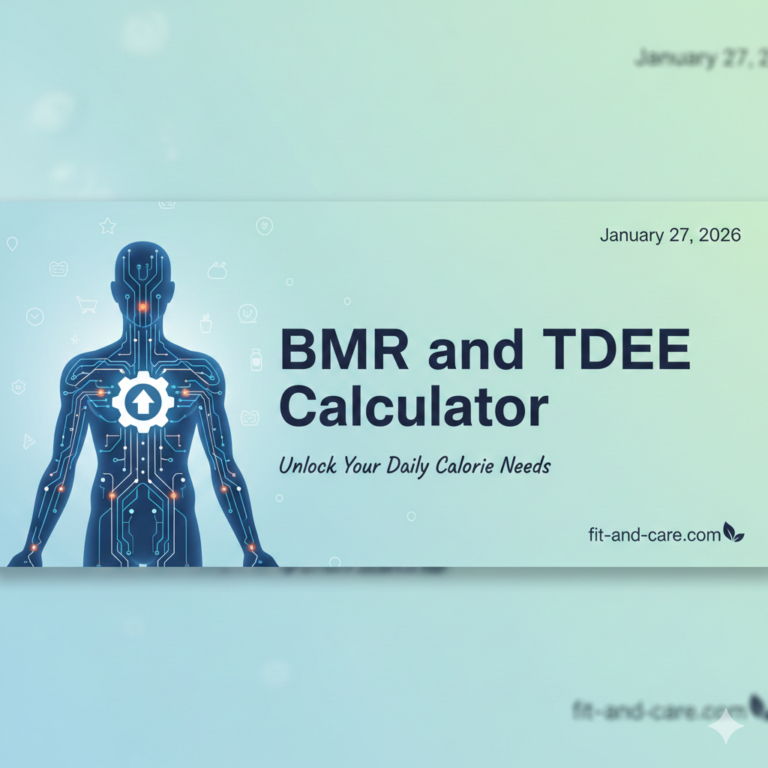
Not sure what your maintenance number is? Our BMR and TDEE calculator works it out in under a minute, and the fiber and protein calculator shows how much protein and fiber to aim for alongside your calories.
Sample Day From the Meal Planner (2,000 Calories, Balanced)
To show how the meal planner scales portions, here is an example of a Balanced day with four meals. The base recipes add up to 1,630 calories, so the planner scales each portion by 1.25 to land close to 2,000.
| Meal | Recipe | Scaled calories | Protein |
|---|---|---|---|
| Breakfast | Greek Yogurt Berry Bowl | 425 | 30 g |
| Lunch | Grilled Chicken Quinoa Bowl | 650 | 50 g |
| Dinner | Baked Salmon & Roasted Veg | 700 | 48 g |
| Snack | Apple & Peanut Butter | 263 | 8 g |
| Total | about 2,038 | about 136 g |
Your own plan will differ because the meal planner picks different combinations each time you press Generate. Use this table as a guide to how portions and totals work.
Why Planning Your Meals Actually Works
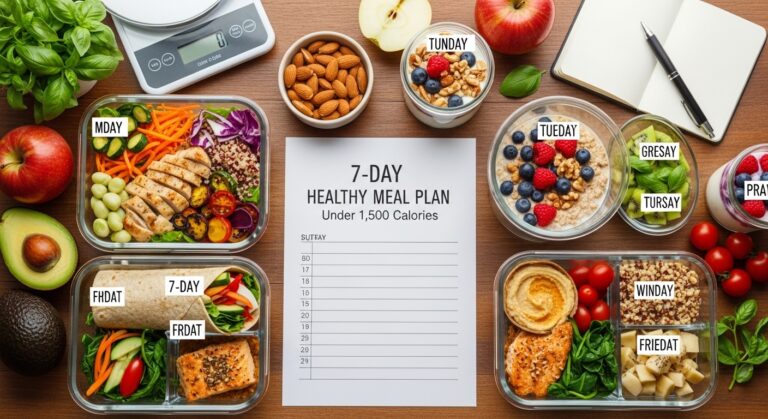
Deciding what to eat is a decision you make dozens of times a week, and decision fatigue is real — by 6 PM after a long day, the path of least resistance usually isn’t the healthiest option on the table. Planning the week in advance removes that decision entirely; you already know what’s for dinner. It also keeps your grocery trips focused. Shopping from a list built around your actual plan — rather than wandering the aisles hungry — is one of the more consistently recommended strategies in the Dietary Guidelines for Americans, which point to planning and preparation as practical levers for eating a more nutritious diet on an everyday basis. If your goal is weight loss specifically, pairing this planner with a defined calorie deficit tends to work better than either approach alone. Our 7-Day Healthy Meal Plan Under 1,500 Calories is a good reference point for what a deficit week can look like.Tips to Get the Most Out of Your Weekly Meal Plan
Know Your Numbers First
A meal plan is only as useful as the calorie target behind it. Run your stats through our BMR and TDEE calculator to find your maintenance calories before deciding whether to eat above or below that number.Batch Cook on Your Prep Day
Pick one day to cook proteins and grains in bulk. Most of the meals in this planner share overlapping ingredients across a diet style, so one prep session covers several days.Track Your Progress, Not Just Your Plate
Meal planning changes what you eat; tracking how your body responds tells you whether it’s working. Our BMI calculator is a simple way to check in periodically alongside your meal plan.Let the Shuffle Button Do the Work
Don’t regenerate the whole week just because you don’t like Tuesday’s dinner. Shuffle that one card and everything else — and your grocery list — adjusts automatically.How to Meal Prep Your Week With This Meal Planner

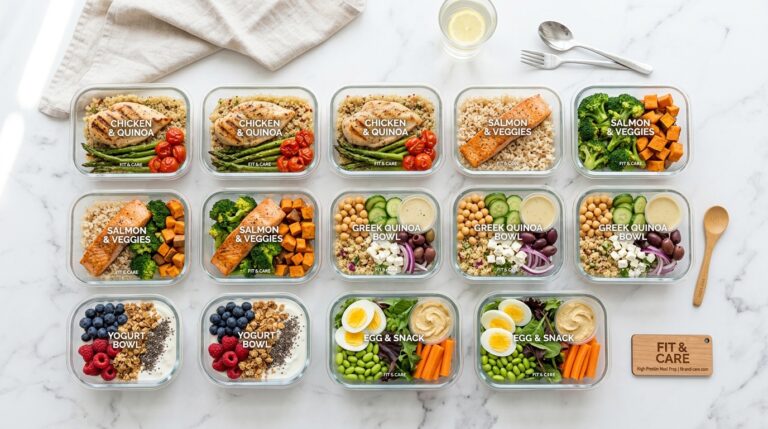
A meal planner removes the “what should I cook” question. Meal prep removes the “I don’t have time” excuse. Together they make healthy eating the easy option. Here is a simple routine:
- Generate your plan and glance at the grocery list before you shop. Cross off anything already in your kitchen.
- Shop once. Buy proteins, produce, grains, dairy and pantry items in the order the list groups them to move through the store faster.
- Cook proteins and grains in bulk. Roast chicken or bake salmon, and cook a big batch of rice or quinoa. Most meals in a diet style share these basics.
- Chop and store vegetables. Washed and cut vegetables in airtight containers make weeknight cooking take minutes.
- Portion into containers. Fill containers to match the planner’s portions so you are not guessing during the week.
- Refrigerate or freeze. Cooked food generally keeps well in the fridge for three to four days, so freeze portions for later in the week.
If you are also working on fiber, our complete fibermaxxing guide shows how to build more beans, lentils and whole grains into your prep.
🛒 Recommended Meal Prep Gear
A few tools make following any weekly meal plan considerably easier:- Glass Meal Prep Containers (Set of 10) — microwave-safe and leak-proof, makes batch-cooked meals easy to portion and grab all week
- Digital Kitchen Food Scale — the fastest way to get comfortable with the portion sizes this planner recommends
- Reusable Produce Bags — handy for keeping a week’s worth of grocery-list produce organised in the fridge
Meal Planner FAQ: Frequently Asked Questions
Is this meal planner free to use?
Yes, the meal planner is completely free, with no account or sign-up required. Generate as many plans as you like.Can I change a single meal without regenerating the whole week?
Yes — click the shuffle button on any individual meal card to swap just that meal. The rest of your week and the grocery list update automatically.How accurate are the calorie and macro numbers?
Portions are scaled to bring each day close to your target, typically within a small margin. These are estimates for planning purposes, not lab-tested values, so treat them as a practical guide rather than an exact figure.Which diet style should I pick if I’m not sure?
Balanced is the safest default for most people. If you have a specific goal — fat loss, muscle gain, or a medical reason to limit carbs — the Keto, High-Protein, or Mediterranean styles may fit better.Can I use this if I have food allergies or intolerances?
The planner doesn’t currently filter by allergen. Review the ingredient list on any generated meal and shuffle to a different option if it includes something you need to avoid.Does the grocery list account for ingredients I already have at home?
Not yet — the list reflects everything needed for the full week’s plan as generated. Cross off what’s already in your pantry before shopping.Related Tools
- Macro & Calorie Planner — find your personalised daily calorie and macro targets
- BMR & TDEE Calculator — calculate your maintenance calories
- BMI Calculator — check in on your progress over time
- 7-Day High-Protein Meal Plan — a done-for-you high-protein week
- 7-Day Healthy Meal Plan Under 1,500 Calories — a structured weight-loss week
- Protein-Rich Foods for Vegetarians — plant-based protein sources explained

Hamza Ahmad is a dedicated fitness and health researcher and the founder of Fit and Care. He specializes in translating evidence-based health science into practical, accessible guidance on nutrition, fitness, and wellness.